Proactive commercial disinfection services eliminate viral pathogens at high-touch surfaces before seasonal illness surges begin.
By engaging dedicated Facility Service Partners to execute targeted touchpoint sanitation prior to autumn transmission peaks, commercial facilities preserve workforce uptime, maintain CDC standards, and avoid the inflated expense of emergency outbreak responses.
Implementing an early-season defense mitigates cross-contamination risk while protecting your operational capacity.
Early autumn brings a predictable surge in viral transmission across commercial, educational, and healthcare facilities as indoor occupancy increases. Waiting until employees call in sick allows pathogens to spread rapidly across shared surfaces. Implementing proactive touchpoint sanitation before transmission peaks neutralizes viruses at the vector source, protecting workforce productivity and stabilizing daily facility operations.
Proactive sanitation maintains a steady, predictable monthly budget line. Reactive approaches generate sharp financial volatility from emergency deep cleans, overtime pay, and productivity losses across multi-year projections.
Unplanned absenteeism costs U.S. commercial operations billions each year in lost productivity and operational friction. Based on current workforce risk metrics, a single unmitigated viral outbreak in a mid-sized facility results in an average productivity decline of 14% across affected departments over a two-week period. Standard visual cleaning methods clear surface dust, but they do not eliminate microscopic viral strains that cause widespread disruption.
When you partner with specialized Facility Service Partners, your facility transitions from defensive cleaning to active risk mitigation. Specialized technicians utilize EPA-registered disinfectants rated to neutralize viral pathogens within target dwell times, ensuring high-traffic zones remain safe for daily occupancy.
Reactive disinfection relies on costly emergency callouts after an outbreak has already disrupted operations and reduced headcount. Proactive facility defense establishes scheduled, risk-mitigated sanitation that maintains baseline hygiene, prevents viral proliferation, and keeps operational budgets predictable without emergency surge fees.
| Operational Factor | Reactive Emergency Cleaning | Proactive Commercial Disinfection Services |
| Service Cost Structure | Premium emergency surge rates | Predictable, controlled operating expense |
| Workforce Impact | High absenteeism (10% to 30% department drops) | Stabilized attendance and preserved productivity |
| Pathogen Reduction | Applied after transmission has occurred | Applied continuously to prevent transmission cycles |
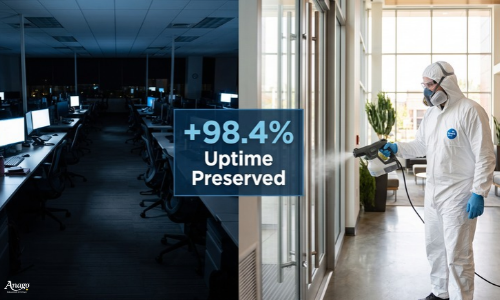
| Facility Disruption | Operational downtime during emergency sweeps | Zero operational friction; performed during off-hours |
| Regulatory Alignment | Scrambling to meet basic hygiene complaints | Continual alignment with CDC standards and OSHA rules |
Pathogens transfer rapidly through indirect contact when an infected individual touches a shared surface, leaving viral particles that survive for hours or days. Subsequent occupants touch the same surface and transfer microorganisms to their eyes, nose, or mouth. Breaking this transfer chain requires systematic, routine sanitation of primary touchpoint vectors using specialized commercial cleaning solutions.
To mitigate cross-contamination across complex environments, Facility Service Partners deploy a four-step systematic protocol:
Verification & Audit: Routine surface monitoring verifies that touchpoints meet required cleanliness metrics without disrupting occupant workflows.
A common misconception among facility directors is that scheduling a massive deep clean after an illness outbreak restores operational safety. In reality, deep cleaning an empty office after half the team is already sick yields minimal operational return on investment.
Viral transmission occurs while people inhabit the building, transferring pathogens from surface to surface in real time. Once an outbreak forces staff home, the primary vectors have already completed their cycle. Scrambling for emergency electrostatic fogging services pays premium rates to solve a problem that has already caused its maximum financial damage. True asset protection relies on establishing barrier sanitation before the first viral wave enters the building.
Protect Your Facility Before the Surge
Don't wait for an outbreak to compromise your workforce productivity and operational schedule. Partner with Anago's experts who understand how to mitigate risk and protect assets throughout the autumn illness surge.
Request Your Customized Facility Risk Assessment today to evaluate your touchpoint vulnerabilities and establish a proactive defense plan built for your facility.
By Darlene Bernd, Content Marketing Manager